
Palo Alto Networks PCNSE Questions and Answers Guarantee you Oass the Test Easily
Share Latest PCNSE DUMP with 250 Questions and Answers
Palo Alto Networks Certified Security Engineer (PCNSE) certification exam is a highly respected certification within the cybersecurity industry. Palo Alto Networks Certified Network Security Engineer Exam certification validates the skills and knowledge of security engineers who work with Palo Alto Networks security technologies. Candidates must possess a deep understanding of the Palo Alto Networks security platform, including advanced knowledge of firewall configuration, management, and troubleshooting, to successfully pass the exam.
NEW QUESTION # 74
Which CLI command enables an administrator to check the CPU utilization of the dataplane?
- A. show system resources
- B. show running resource-monitor
- C. debug data-plane dp-cpu
- D. debug running resources
Answer: B
Explanation:
Explanation
https://knowledgebase.paloaltonetworks.com/KCSArticleDetail?id=kA10g000000ClXwCAK
NEW QUESTION # 75
A firewall administrator has completed most of the steps required to provision a standalone Palo Alto Networks Next-Generation Firewall. As a final step, the administrator wants to test one of the security policies.
Which CLI command syntax will display the rule that matches the test?
- A. test security -policy- match source <ip_address> destination <IP_address> destination port <port number> protocol <protocol number
- B. show security-policy-match source <ip_address> destination <IP_address> destination port <port number> protocol <protocol number>
- C. test security rule source <ip_address> destination <IP_address> destination port <port number> protocol <protocol number>
- D. show security rule source <ip_address> destination <IP_address> destination port <port number> protocol <protocol number>
Answer: A
Explanation:
test security-policy-match source
Explanation:
test security-policy-match source <source IP> destination <destination IP> protocol <protocol number>
https://live.paloaltonetworks.com/t5/Management-Articles/How-to-Test-Which-Security-Policy-Applies-to-a-Traffic-Flow/ta-p/53693
NEW QUESTION # 76
A firewall engineer is configuring quality of service (OoS) policy for the IP address of a specific server in an effort to limit the bandwidth consumed by frequent downloads of large files from the internet.
Which combination of pre-NAT and / or post-NAT information should be used in the QoS rule?
- A. Post-NAT source IP address Pre-NAT source zone
- B. Pre-NAT source IP address Post-NAT source zone
- C. Pre-NAT source IP address Pre-NAT source zone
- D. Post-NAT source IP address Post-NAT source zone
Answer: C
Explanation:
When configuring Quality of Service (QoS) policies, particularly for traffic going to or from specific IP addresses and involving NAT, it's important to base the rule on how the firewall processes the traffic. For QoS, the firewall evaluates traffic using pre-NAT IP addresses and zones because QoS policies typically need to be applied before the NAT action occurs. This is especially true for inbound traffic, where the goal is to limit bandwidth before the destination IP is translated.
The correct combination for a QoS rule in this scenario, where the aim is to limit bandwidth for downloads from a specific server (implying inbound traffic to the server), would be:
D . Pre-NAT source IP address Pre-NAT source zone:
Pre-NAT source IP address: This refers to the original IP address of the client or source device before any NAT rules are applied. Since QoS policies are evaluated before NAT, using the pre-NAT IP address ensures that the policy applies to the correct traffic.
Pre-NAT source zone: This is the zone associated with the source interface before NAT takes place. Using the pre-NAT zone ensures that the QoS policy is applied to traffic as it enters the firewall, before any translations or routing decisions are made.
By configuring the QoS rule with pre-NAT information, the firewall can accurately apply bandwidth limitations to the intended traffic, ensuring efficient use of network resources and mitigating the impact of large file downloads from the specified server.
For detailed guidelines on configuring QoS policies, refer to the Palo Alto Networks documentation, which provides comprehensive instructions and best practices for managing bandwidth and traffic priorities on the network.
NEW QUESTION # 77
Which steps should an engineer take to forward system logs to email?
- A. Create a new email profile under Device > server profiles; then navigate to Objects > Log Forwarding profile > set log type to system and the add email profile.
- B. Create a new email profile under Device > server profiles: then navigate to Device > Log Settings > System and add the email profile under email.
- C. Enable log forwarding under the email profile in the Device tab.
- D. Enable log forwarding under the email profile in the Objects tab.
Answer: B
Explanation:
Explanation
An email profile defines the email server and sender address for sending email notifications from the firewall or Panorama. To forward system logs to email, the engineer needs to create a new email profile under Device
> Server Profiles > Email and configure the required settings, such as SMTP server, sender email address, and recipient email address. Then, the engineer needs to navigate to Device > Log Settings > System and select the email profile under Email for each severity level of system logs that need to be forwarded. Enabling log forwarding under the email profile in the Objects tab or in the Device tab is not possible, as log forwarding profiles are configured under Objects > Log Forwarding. Log forwarding profiles are used for forwarding threat, traffic, URL filtering, data filtering, HIP match, configuration, and correlation logs, not system logs.
References:
https://docs.paloaltonetworks.com/pan-os/9-1/pan-os-admin/monitoring/configure-email-alerts
https://docs.paloaltonetworks.com/pan-os/9-1/pan-os-admin/monitoring/configure-log-forwarding
NEW QUESTION # 78
An engineer is tasked with configuring SSL forward proxy for traffic going to external sites.
Which of the following statements is consistent with SSL decryption best practices?
- A. The forward untrust certificate should be signed by a certificate authority that is trusted by the clients.
- B. The forward untrust certificate should not be signed by a Trusted Root CA
- C. The forward trust certificate should not be stored on an HSM.
- D. Check both the Forward Trust and Forward Untrust boxes when adding a certificate for use with SSL decryption
Answer: A
Explanation:
Explanation
According to the PCNSE Study Guide , SSL forward proxy is a feature that allows the firewall to decrypt and inspect SSL traffic going to external sites. The firewall acts as a proxy between the client and the server, generating a certificate on the fly for each site.
The best practices for configuring SSL forward proxy are
Use a forward trust certificate that is signed by a certificate authority (CA) that is trusted by the clients.
This certificate is used to sign certificates for sites that have valid certificates from trusted CAs. The clients will not see any certificate errors if they trust the forward trust certificate.
Use a forward untrust certificate that is not signed by a trusted CA. This certificate is used to sign certificates for sites that have invalid or untrusted certificates. The clients will see certificate errors if they do not trust the forward untrust certificate. This helps alert users of potential risks and prevent man-in-the-middle attacks.
Do not store the forward trust or untrust certificates on an HSM (hardware security module). The HSM does not support on-the-fly signing of certificates, which is required for SSL forward proxy.
NEW QUESTION # 79
An existing NGFW customer requires direct interne! access offload locally at each site and iPSec connectivity to all branches over public internet. One requirement is mat no new SD-WAN hardware be introduced to the environment.
What is the best solution for the customer?
- A. Configure policy-based forwarding
- B. Upgrade to a PAN-OS SD-WAN subscription
- C. Configure a remote network on PAN-OS
- D. Deploy Prisma SD-WAN with Prisma Access
Answer: B
Explanation:
According to the Palo Alto Networks documentation, "The PAN-OS software now includes a native SD-WAN subscription to provide intelligent and dynamic path selection on top of the industry-leading security that PAN-OS software already delivers. Key features of the SD-WAN implementation include centralized configuration management, automatic VPN topology creation, traffic distribution, monitoring, and troubleshooting."
NEW QUESTION # 80
An engineer wants to configure aggregate interfaces to increase bandwidth and redundancy between the firewall and switch. Which statement is correct about the configuration of the interfaces assigned to an aggregate interface group?
- A. They can have different hardware media such as the ability to mix fiber optic and copper.
- B. They can have a different interface type from an aggregate interface group.
- C. They can have a different bandwidth.
- D. They can have a different interface type such as Layer 3 or Layer 2.
Answer: A
Explanation:
Explanation
https://docs.paloaltonetworks.com/pan-os/9-1/pan-os-admin/networking/configure-interfaces/configure-an-aggre
NEW QUESTION # 81
Match each type of DoS attack to an example of that type of attack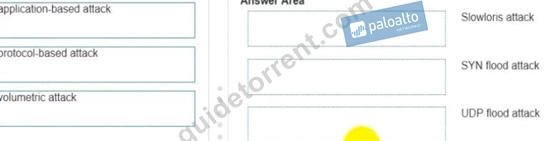
Answer:
Explanation: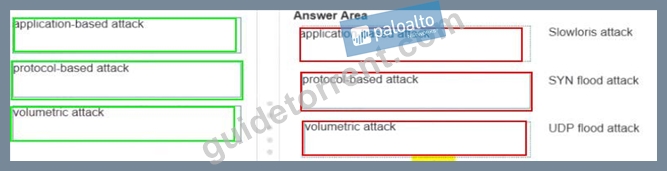
NEW QUESTION # 82
A company needs to preconfigure firewalls to be sent to remote sites with the least amount of reconfiguration. Once deployed, each firewall must establish secure tunnels back to multiple regional data centers to include the future regional data centers.
Which VPN configuration would adapt to changes when deployed to the future site?
- A. Preconfigured PIsec tunnels
- B. Preconfigured PPTP Tunnels
- C. Preconfigured GlobalProtect client
- D. Preconfigured GlobalProtect satellite
Answer: D
NEW QUESTION # 83
Which two virtualization platforms officially support the deployment of Palo Alto Networks VM- Series firewalls? (Choose two.)
- A. Microsoft Hyper-V
- B. Kernel Virtualization Module (KVM)
- C. Red Hat Enterprise Virtualization (RHEV)
- D. Boot Strap Virtualization Module (BSVM)
Answer: A,B
Explanation:
Reference: https://www.paloaltonetworks.com/products/secure-the-network/virtualized-next- generation-firewall/vm-series
NEW QUESTION # 84
A customer wants to set up a VLAN interface for a Layer 2 Ethernet port.
Which two mandatory options are used to configure a VLAN interface? (Choose two.)
- A. Virtual router
- B. ARP entries
- C. Security zone
- D. Netflow Profile
Answer: A,C
NEW QUESTION # 85
Which GlobalProtect gateway setting is required to enable split-tunneling by access route, destination domain, and application?
- A. Tunnel mode
- B. IPSec mode
- C. Satellite mode
- D. No Direct Access to local networks
Answer: A
Explanation:
To enable split-tunneling by access route, destination domain, and application, you need to configure a split tunnel based on the domain and application on your GlobalProtect gateway. This allows you to specify which domains and applications are included or excluded from the VPN tunnel.
NEW QUESTION # 86
In a security-first network what is the recommended threshold value for content updates to be dynamically updated?
- A. 6 to 12 hours
- B. 36 hours
- C. 24 hours
- D. 1 to 4 hours
Answer: A
Explanation:
Explanation
https://docs.paloaltonetworks.com/pan-os/8-1/pan-os-admin/threat-prevention/best-practices-for-content-and-thre
NEW QUESTION # 87
Which CLI command displays the physical media that are connected to ethernet1/8?
- A. > show system state filter-pretty sys.sl.p8.phy
- B. > show system state filter-pretty sys.sl.p8.med
- C. > show system state filter-pretty sys.si.p8.stats
- D. > show interface ethernet1/8
Answer: A
Explanation:
Explanation
Example output:
> show system state filter-pretty sys.s1.p1.phy
sys.s1.p1.phy: {
link-partner: { },
media: CAT5,
type: Ethernet,
}
https://knowledgebase.paloaltonetworks.com/KCSArticleDetail?id=kA10g000000Cld3CAC
NEW QUESTION # 88
Drag and Drop Question
Below are the steps in the workflow for creating a Best Practice Assessment in a firewall and Panorama configuration. Place the steps in order.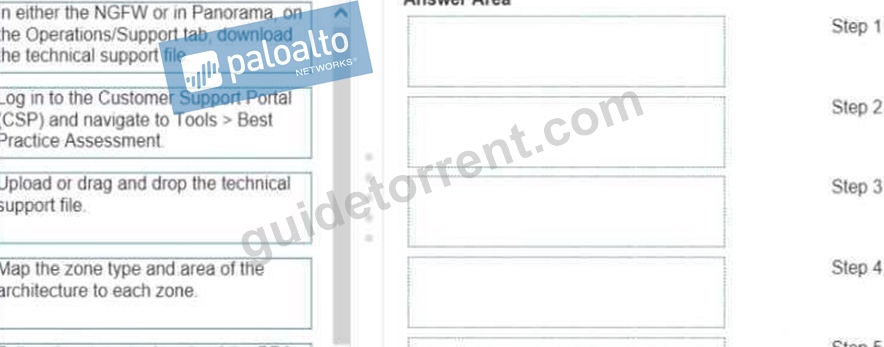
Answer:
Explanation: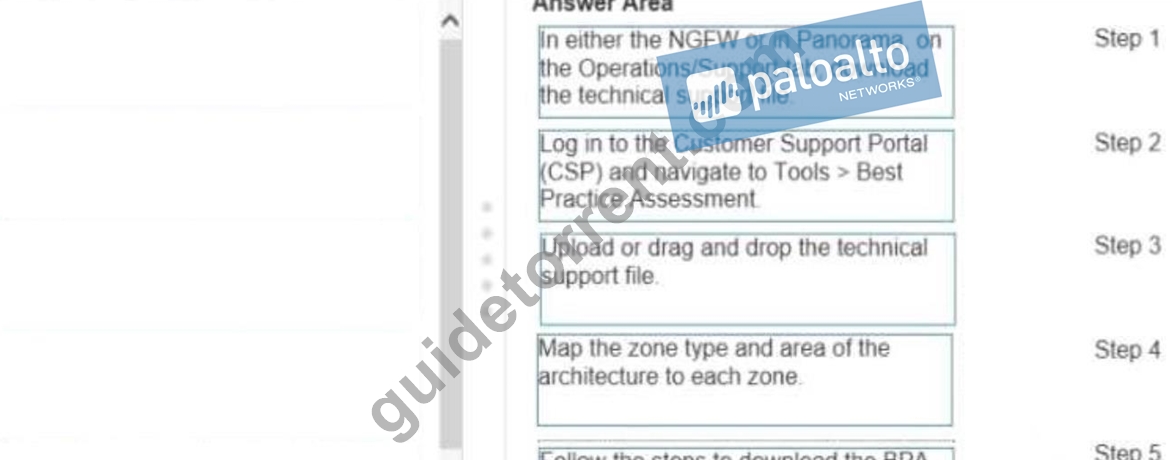
Explanation:
https://www.paloaltonetworks.com/resources/videos/how-to-run-a-bpa
NEW QUESTION # 89
A superuser is tasked with creating administrator accounts for three contractors For compliance purposes, all three contractors will be working with different device-groups in their hierarchy to deploy policies and objects.
Which type of role-based access is most appropriate for this project?
- A. Create a Custom Panorama Admin
- B. Create a Dynamic Admin with the Panorama Administrator role
- C. Create a Device Group and Template Admin
- D. Create a Dynamic Read only superuser
Answer: C
NEW QUESTION # 90
Which feature can provide NGFWs with User-ID mapping information?
- A. Native 802.1q authentication
- B. Native 802.1x authentication
- C. GlobalProtect
- D. Web Captcha
Answer: C
Explanation:
Explanation
https://docs.paloaltonetworks.com/pan-os/8-1/pan-os-admin/user-id/user-id-concepts/user-mapping.html
NEW QUESTION # 91
Which protection feature is available only in a Zone Protection Profile?
- A. UDP Flood Protections
- B. SYN Flood Protection using SYN Flood Cookies
- C. Port Scan Protection
- D. ICMP Flood Protection
Answer: C
NEW QUESTION # 92
WildFire will submit for analysis blocked files that match which profile settings?
- A. files that are blocked by a File Blocking profile
- B. files that are blocked by URL filtering
- C. files matching Anti-Spyware signatures
- D. files matching Anti-Virus signatures
Answer: D
Explanation:
Explanation
https://docs.paloaltonetworks.com/wildfire/u-v/wildfire-whats-new/latest-wildfire-cloud-features/wildfire-analys
NEW QUESTION # 93
A firewall administrator is investigating high packet buffer utilization in the company firewall. After looking at the threat logs and seeing many flood attacks coming from a single source that are dropped by the firewall, the administrator decides to enable packet buffer protection to protect against similar attacks.
The administrator enables packet buffer protection globally in the firewall but still sees a high packet buffer utilization rate.
What else should the administrator do to stop packet buffers from being overflowed?
- A. Add the default Vulnerability Protection profile to all security rules that allow traffic from outside.
- B. Add a Zone Protection profile to the affected zones.
- C. Apply DOS profile to security rules allow traffic from outside.
- D. Enable packet buffer protection for the affected zones.
Answer: D
NEW QUESTION # 94
An administrator wants to upgrade an NGFW from PAN-OS 9.0 to PAN-OS 10.0. The firewall is not a part of an HA pair. What needs to be updated first?
- A. PAN-OS Upgrade Agent
- B. Applications and Threats
- C. XML Agent
- D. WildFire
Answer: B
Explanation:
Explanation
https://www.paloaltonetworks.com/documentation/80/pan-os/newfeaturesguide/upgrade-to-pan-os-80/upgrade-th
NEW QUESTION # 95
Which virtual router feature determines if a specific destination IP address is reachable?
- A. Heartbeat Monitoring
- B. Path Monitoring
- C. Failover
- D. Ping-Path
Answer: B
Explanation:
Explanation/Reference:
Reference: https://www.paloaltonetworks.com/documentation/80/pan-os/pan-os/policy/policy-based- forwarding/pbf/path-monitoring-for-pbf
NEW QUESTION # 96
A bootstrap USB flash drive has been prepared using a Windows workstation to load the initial configuration of a Palo Alto Networks firewall that was previously being used in a lab. The USB flash drive was formatted using file system FAT32 and the initial configuration is stored in a file named init-cfg txt. The firewall is currently running PAN-OS 10.0 and using a lab config The contents of init-cfg txi in the USB flash drive are as follows: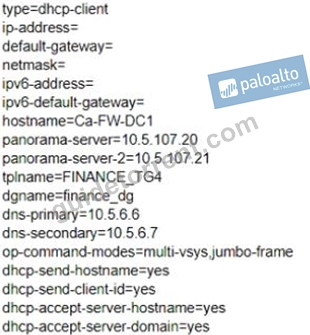
The USB flash drive has been inserted in the firewalls' USB port, and the firewall has been restarted using command:> request resort system Upon restart, the firewall fails to begin the bootstrapping process. The failure is caused because
- A. PANOS version must be 91.x at a minimum but the firewall is running 10.0.x
- B. The hostname is a required parameter, but it is missing in init-cfg txt
- C. The bootstrap.xml file is a required file but it is missing
- D. Firewall must be in factory default state or have all private data deleted for bootstrapping
- E. The USB must be formatted using the ext3 file system, FAT32 is not supported
Answer: E
Explanation:
https://docs.paloaltonetworks.com/pan-os/8-1/pan-os-admin/firewall-administration/bootstrap-the-firewall/bootstrap-a-firewall-using-a-usb-flash-drive.html#id8378007f-d6e5-4f2d-84a4-5d50b0b3ad7d
NEW QUESTION # 97
As a best practice, logging at session start should be used in which case?
- A. Only when log at session end is enabled
- B. While troubleshooting
- C. On all Allow rules
- D. Only on Deny rules
Answer: B
Explanation:
https://knowledgebase.paloaltonetworks.com/KCSArticleDetail?id=kA10g000000Clt5CAC#:~:text
=Logging%20at%20session%20start%20is,on%20the%20management%20plane's%20CPU.
NEW QUESTION # 98
......
The PCNSE certification exam is a comprehensive exam that covers a wide range of topics related to the Palo Alto Networks platform. PCNSE exam is designed to test the skills and knowledge of security engineers in areas such as firewall configuration, network security, threat prevention, and VPN configuration. The PCNSE exam is a timed exam that consists of multiple-choice questions, and candidates must score at least 70% to pass the exam. The PCNSE certification is valid for two years, after which candidates must recertify to maintain their certification.
Palo Alto Networks Certified Security Engineer (PCNSE) certification is a widely recognized and respected credential in the network security industry. Palo Alto Networks Certified Network Security Engineer Exam certification validates the knowledge and skills of IT professionals in designing, deploying, configuring, maintaining, and troubleshooting Palo Alto Networks’ next-generation firewalls and related products. The PCNSE certification is an intermediate-level credential that requires passing a rigorous exam that covers topics such as firewall architecture, security policies, network security, and threat prevention.
Dumps for Free PCNSE Practice Exam Questions: https://torrentpdf.guidetorrent.com/PCNSE-dumps-questions.html