


Demanding exams and busy schedules collide for most IT professionals, and the CIMAPRO19-P01-1 exam is no exception. GuideTorrent resolves that collision with 258 verified practice questions for the CIMA Management Accounting exam that respect the time you actually have.
CIMA CIMAPRO19-P01-1 Exam Syllabus Topics:
| Section | Weight | Objectives |
|---|---|---|
| Short-Term Commercial Decision Making | 30% | - Working capital management - Pricing decisions and make-or-buy choices - Break-even and limiting factor analysis - Relevant costing and opportunity costs |
| Budgeting and Budgetary Control | 25% | - Flexible budgets and budgetary control - Quantitative analysis for forecasting - Behavioural aspects of budgeting - Budget preparation and approaches |
| Cost Accounting for Decision and Control | 30% | - Standard costing and variance analysis - Cost classification and behaviour - Absorption, marginal and activity-based costing - Costing methods and techniques |
| Dealing with Uncertainty in the Short Term | 15% | - Expected values and decision trees - Basic internal control and risk management - Risk and uncertainty concepts - Sensitivity analysis and simulation |
CIMAPRO19-P01-1 Material FAQ
The CIMA Management Accounting exam requires a score of 100/150 scaled score (approx. 67%) to pass, and the official registration fee is USD $115–$195 / GBP £95–£165 (varies by region and membership status). Because the fee is significant, preparing thoroughly the first time is the practical choice.
Every session in the test engine is scored and broken down, so you see clearly which topics you handle well and which ones keep costing you points. That picture tells you where your remaining study time belongs — a far better guide than rereading everything evenly.
The CIMA Management Accounting exam contains 60 questions, and you will have 90 minutes minutes to complete them. Practicing within the same limits builds the pacing the real exam demands.
No mandatory prerequisites; open to all students; exemptions available via AAT, ACCA, ACA or relevant degrees
You can confirm the current eligibility requirements on the official CIMAPRO19-P01-1 exam page before you register.
This package includes 258 practice questions for the CIMA Management Accounting exam. Every answer is verified by an experienced team of experts, so you can trust what you study.
You can register for the CIMA Management Accounting exam through the official channels:
Yes. Once downloaded, the online test engine keeps running without an internet connection, on Windows, Mac, Android, or iOS. That means practice continues on flights, in waiting rooms, and anywhere else your day takes you — your CIMAPRO19-P01-1 preparation never has to pause for a missing signal.
The CIMA Management Accounting practice questions are organized around the official exam objectives. Key topics include:
- Cost Accounting for Decision and Control (30%)
- Dealing with Uncertainty in the Short Term (15%)
- Short-Term Commercial Decision Making (30%)
Comparing your practice scores against these topics shows you where the next session should go.
Many candidates combine practice questions with official training. Recommended options include:
CIMA Management Accounting Sample Questions:
The standard production cost of making a product is as follows: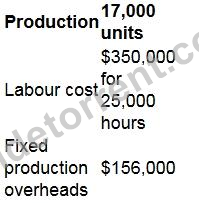
What is the fixed production overhead capacity variance?
- A. $3,000F
- B. $9,000F
- C. $6,000A
- D. $6,000F
Correct Answer: D 🗳️
Your company want to know how many units they'd have to sell this season to break even. However, you have some reservations over whether or not breakeven analysis is suitable for the company.
Which of these assumptions over product range limit the accuracy of break even analysis? Select ALL that apply.
- A. The company only sells one product
- B. The company has a consistent selling ratio across all products
- C. The company has a variable selling ratio across all products
- D. Variable costs remain consistent at any level of production
- E. Fixed costs remain the same regardless of activity
- F. Prices and demand of products will remain steady
- G. The company sells multiple products
Correct Answer: A,B 🗳️
A company sells and services photocopying machines. Its sales department sells the machines and consumables, including ink and paper, and its service department provides an after sales service to its customers. The after sales service includes planned maintenance of the machine and repairs in the event of a machine breakdown. Service department customers are charged an amount per copy that differs depending on the size of the machine.
The company's existing costing system uses a single overhead rate, based on total sales revenue from copy charges, to charge the cost of the Service Department's support activities to each size of machine.
The Service Manager has suggested that the copy charge should more accurately reflect the costs involved. The company's accountant has decided to implement an activity-based costing system and has obtained the following information about the support activities of the service department: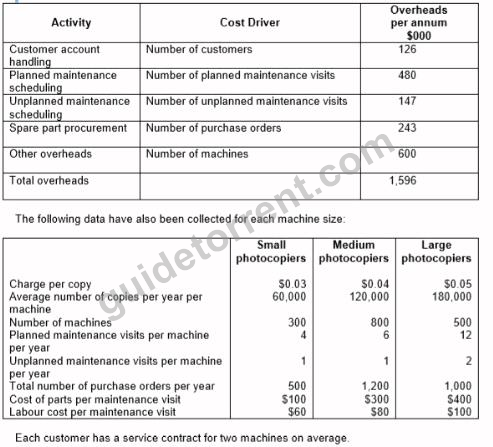
Calculate the annual profit per machine for each of the three sizes of machine, using the current basis for charging the costs of support activities to machines.
- A. The profit per machine for the medium machine was: $1350
- B. The profit per machine for the medium machine was: $1376
- C. The profit per machine for the medium machine was: $1276
- D. The profit per machine for the medium machine was: $1250
Correct Answer: C 🗳️
For the forthcoming period, the number of units of product L produced must be no more than four times the number of units of product M produced.
The equation to represent this constraint in a linear programming exercise is:
- A. L > 4M
- B. 4L > M
- C. 4L < M
- D. L < 4M
Correct Answer: D 🗳️
Which of the following explain why standard costing is less appropriate in the contemporary business environment?
1. In a continuous improvement environment standard costing can restrict the impetus to remain as cost competitive as rivals.
2. Fixed overhead variances are less relevant as fixed costs represent a decreasing proportion of total manufacturing cost.
3. In a just-in-time environment there are fewer costs to control.
- A. 1 only
- B. 2 and 3
- C. 1 and 3
- D. 1 and 2
Correct Answer: A 🗳️
Viewing page 1 out of 52 pages.
Viewing questions 1-5 out of 258 questions.


